Cruze hits the Drag Strip

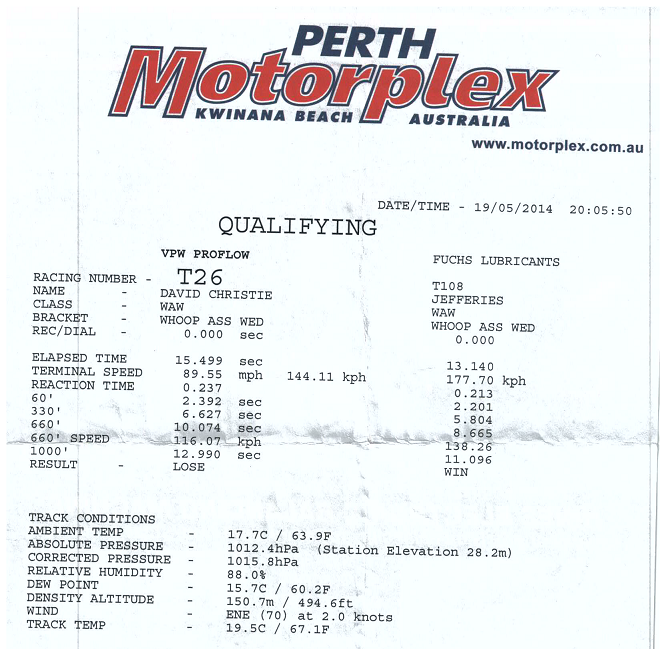
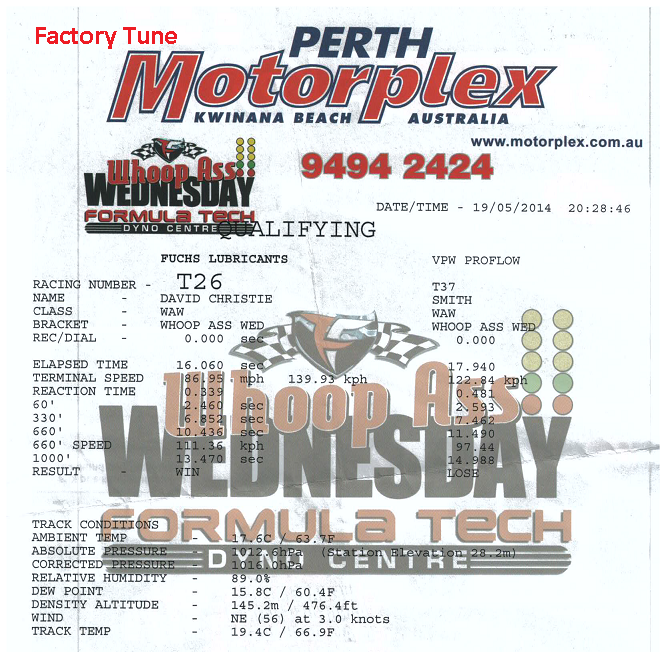
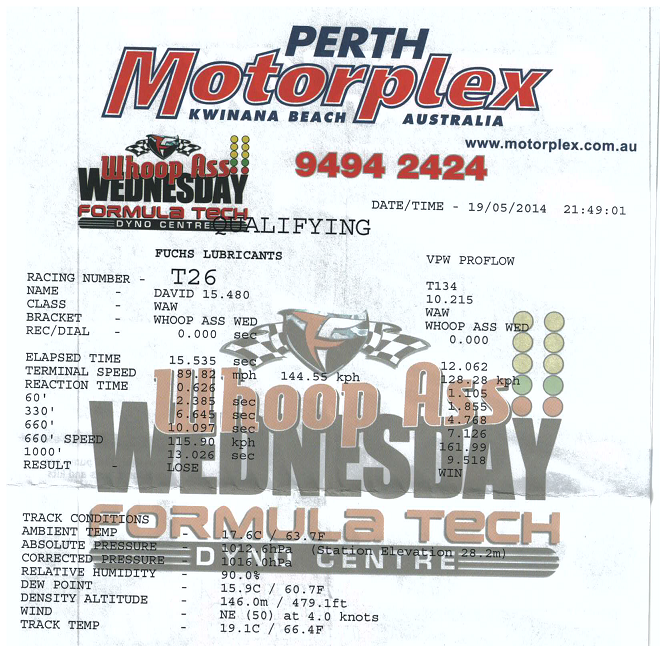
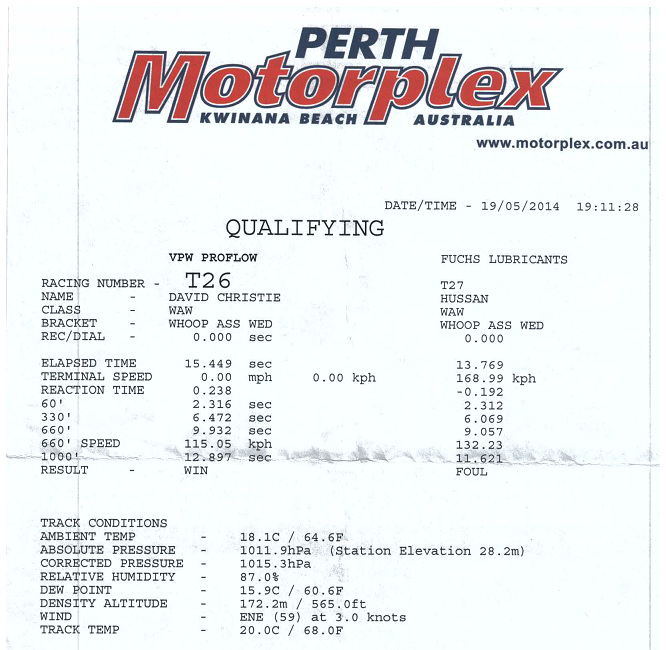
While being one of the slowest cars I’ve ever had to race, I was wanting to confirm the power upgrade from the ecu retune, So I took the Cruze to the drag strip this last week and as expected considerable gains were had between the factory & the Torque Up Tune.

So as not to bias the car against any temperature changes or heat soak in the staging lanes, The factory tune was uploaded between runs of the modified tune.

cruze-tutune2
Custom Tune Results
cruze-tutune3
Custom Tune Results
Stock Tune Results
Stock Tune Results
cruze-tutune1
Custom Tune Results

As can be seen from the results there is a minimum 4kph difference at the half track which carries all the way through to the speed trap at the end of the 1/4.

The biggest problem with trying to get the cruze off the line quickly is actually wheel spin believe it or not, since it doesn’t have a Limited Slip diff it starts to axle hop as the boost comes on in 1st gear. If the car was an auto it’s quite possible a high 14 second time slip would be possible.

Cruze 1.6T Air Intake

Not happy with the non-existent turbo noise/spool sound, I did some investigating of the factory air intake today and took some pictures along the way.

Unfortunately to do anything with the factory system, it requires removing the front bar which is about a 5-10 minute job. Once that’s done it’s a pretty simple process of removing a single 10mm bolt that holds the snorkel from the front of the car to the lower air box muffler.

The factory air box in the engine bay simply lifts out once the MAF plug and intake pipe are removed, providing access to the lower air box muffler.

cruze-bumper-removal
Factory Air intake setup
cruze-snorkel
Air intake snorkel
cruze-airbox-guard
Guard with rubber coupler in place
cruze-airbox-removed
Guard with coupler removed
Cruze-top-airbox
Factory MAF sensor in the top of the airbox
cruze-lower-airbox-restriction2
Lower airbox muffler bottom
cruze-lower-airbox-restriction
Lower airbox muffler top
cruze-lower-airbox
Lower air box muffler removed

I was surprised by what can only be seen as a somewhat over the top and restrictive intake system for such a small car. Not even the latest & greatest VF V8’s go this far!

So far for testing I have just removed the lower portion of the air box which I am calling a “muffler” box. While still retaining the front air dam director in place.

While there are aftermarket solutions available for the 1.4T to replace the factory kit, there are currently none being marketed to suit the 1.6T & All though the same kits may fit, I will let someone else take the chance. Personally for the price I believe I can have one made up to suit locally and that will be my next step.

For now, I’ve at least checked to see if it will be possible for what I have in mind for Phase 2 and once that’s done, maybe Phase 3 will be a new front mount intercooler and pipe work? Who knows.

cruze-Stage2
Phase 2 Pod Filter setup

Turbo Cruze Tuning

I wrote the following for a forum reply in regards to a question on how you get more power out of the cruze 1.6 turbo motors, as time goes by I will update this page or add some new “blogs”.

The ecu in the Opel Astra / Cruze / Barina / Sonic range and pretty much all the new gm ecu modules are moving towards torque based ecu’s/calibrations.

Essentially what this means is that the throttle pedal is no longer directly in control of the throttle blade and there for how much power you make, Logically or behaviourily you think the more you push the throttle down, the more the throttle blade opens and therefore the car will make more power.

Now the pedal simply act’s as an input into the ecu as a torque request, Of which there are generally 2. Driver demand (based on accelerator pedal position and road speed or rpm), the other “torques” you need to know is engine output. The control algorithm adjusts engine output (via fuel delivery, throttle position, boost pressure & spark) until it matches driver demand.

How does it know how much torque the engine is making without measuring it -> simple, the ECU contains mathematical models and maps that calculate it based on known input conditions. If you know how much fuel & air is going in, and the engine RPM, and the status of the A/C compressor and alternator, and the amount of friction that the engine has under those conditions, the amount of torque output can be calculated.

Now for the “fuel talk” i’ll be a little less thorough.
The factory tune, tries to keep the car running at stoich (14.7afr) aka lambda 1 as much as possible, even under boost. this is great for fuel economy & emissions. bad for power and potentially engine parts if it’s ran hot for lengthy periods, which is what running at stoich does under boost. At cruise to light to moderate loads this is fine.

Now that we know heat kills engine parts, especially pistons and all that heat goes straight into the catalytic convertor after the turbo, which ironically requires a very high temperature to become efficient in burning out crap that we didnt burn in the combustion champer. we are now left with a potentially red hot steel chamber and to reduce/prevent this from going chernoble on the car they then calculate the temperature of the cat within the ecu. if it’s gets into a certain range it will enrichen the fuel. in our case down to 9AFR which is super duper rich. The purpose is obvious, more unburnt fuel to cool the cat down, but it kills power.

See where im going with this?

Timing wise, this is really simple. There are multiple tables that affect the overall amount of timing the engine commands, these are either based on knock feedback, air & water temp sensors, ethanol percentage or based on the commanded fuel enrichment. each table is setup in it’s own unique way, but not all of them are either used or require to be used. Just depends on how you want to calibrate the output at the end.

In conclusion, In stock form the tune for the cruze & opel 1.6t is woeful and im my opinion has not been calibrated correctly at all, it’s like someone was given a year to come up with a tune from scratch and then 2 weeks in just went fuck it. that’s good enough, but i guess that because they sell it as a “cheap” car they didnt want to spend too much engineering time on it.

RaceWars 2014

Another year and another successful RaceWars weekend.

I only took 1 car this year and that was my brothers VE SS Commodore. With it’s very old blower & cam combo making 630rwhp with the stock 6LT it did very well with an overall 10th placing for the top speed and 2nd place for v8’s.

1000m results were:

Run 1:
267.23 km/h
21.514 s
[youtube]s6x-v_GQEzo[/youtube]
Run 2:
269.53 km/h
21.255 s
[youtube]uchQwcQ5t4k[/youtube]
Run 3:
269.81 km/h
21.343 s
[youtube]WZcgcpbKgp4[/youtube]
Outright Position:
10th
Best Class Position:
2nd  (8 Cylinder)
Fastest Run:
269.81 km/h
21.343 s

Pump E85 Finally in WA

United Fuel stations are starting the rollout of of E85 to their stations across Perth, with Armadale being the 1st.

As the very first paying customer on the new pump, initial testing shows the ethanol content at 80% which is fantastic for the first tanker load.

e85-bowser

ethanol-content

Racewars 2013 roundup

So the first of hopefully many future events was held over the weekend of the 7-8th of April just gone at a small town called Wyalkatchem about 200km’s east of the Perth cbd.

The event consisted of 2 days of racing at the local airstrip which is approximately 1540 meters long, with a live band for entertainment playing Saturday night at the local bowls club. Most if not all accommodation in town was booked out shortly after the event went on sale with a dedicated area set aside at the town oval for competitors & spectators alike to camp. However my dad, his friend & myself stayed at the Dowerin Pub/Motel a mere 30km’s away, and man do they make a killer surf & turf.

Anyway on with the event, Entries were limited to 200 competitors of which only about 175~180 turned up due to either breakages before the event or just not having vehicles complete in time. There was a regular entry fee of $250 or you could upgrade to VIP for another $250 all of which was non-refundable so as to provide a guaranteed financial kitty. I went VIP for 1 car and normal for the other as it allowed me to essentially “jump” the queue when I went out. Luckily for me I was upgraded to VIP for my second car at no additional cost. Which helped with the logistics side if i needed to work on either car or move camera’s around.

VIP entrants had a paved carpark and also got you a free lunch, access to the main airport building/toilets, tv and power to charge laptops/camera’s etc.

The main purpose of this event was to hold the standstill to 1000m timed event on the sunday, however it also consisted of roll on 400/800 drag racing on Saturday in which you could even have a passenger in the vehicle. Sunday then kicked off with the continuation of the 800 meter roll on racing again as the drivers preferred the roll on racing to the start lights as it meant less waiting time and more track time and helped those with high horsepower vehicles from spinning the wheels off the line for the first 400 meters 😉

Unfortunately during the sunday morning 800m roll on sessions Eddie from Active Automotive & a passenger in his yellow monaro had a roll over at around the 400 meter mark. I don’t know or want to guess what caused it, but luckily this particular car has a very decent roll cage that could take such an accident and both Ed & passenger were rescued pretty quickly by the onsite fire/ambo crews and were both walking around shortly after, However as a precaution they were airlifted back to Perth later in the day via RFDS.

Over both days there was a steady stream of spectators coming in and I’m lead to believe they had over 1700 spectators on the Saturday alone, with an additional 1300 on the sunday which is bloody incredible considering it’s at least a 2 hr drive just from Perth. Some competitors travelled around 1300km’s all up to compete so they were definitely keen.

We trailered 2 car’s there and I drove my VE there and back (including racing) with just an additional 20lt jerry can and still got back into Perth with over 1/4 tank.

Unfortunatly there was some issues with the timing equipment first thing sunday morning so one of my 1000m runs wasn’t timed (bugger as it was cooler and log showed more boost) than the afternoon run. Full results haven’t been released yet either but i asked for my data on the return to the pits. From memory my vy ute went 243kph vs 255kph in the VE, in which i have to take on face value for this year as the ute doesn’t hold a candle to the VE in power nor accelleration to have such a small margin. That and my logs for the same time show a much higher speed.